Triton 47 › AI & computation › The maker turn
Android to android
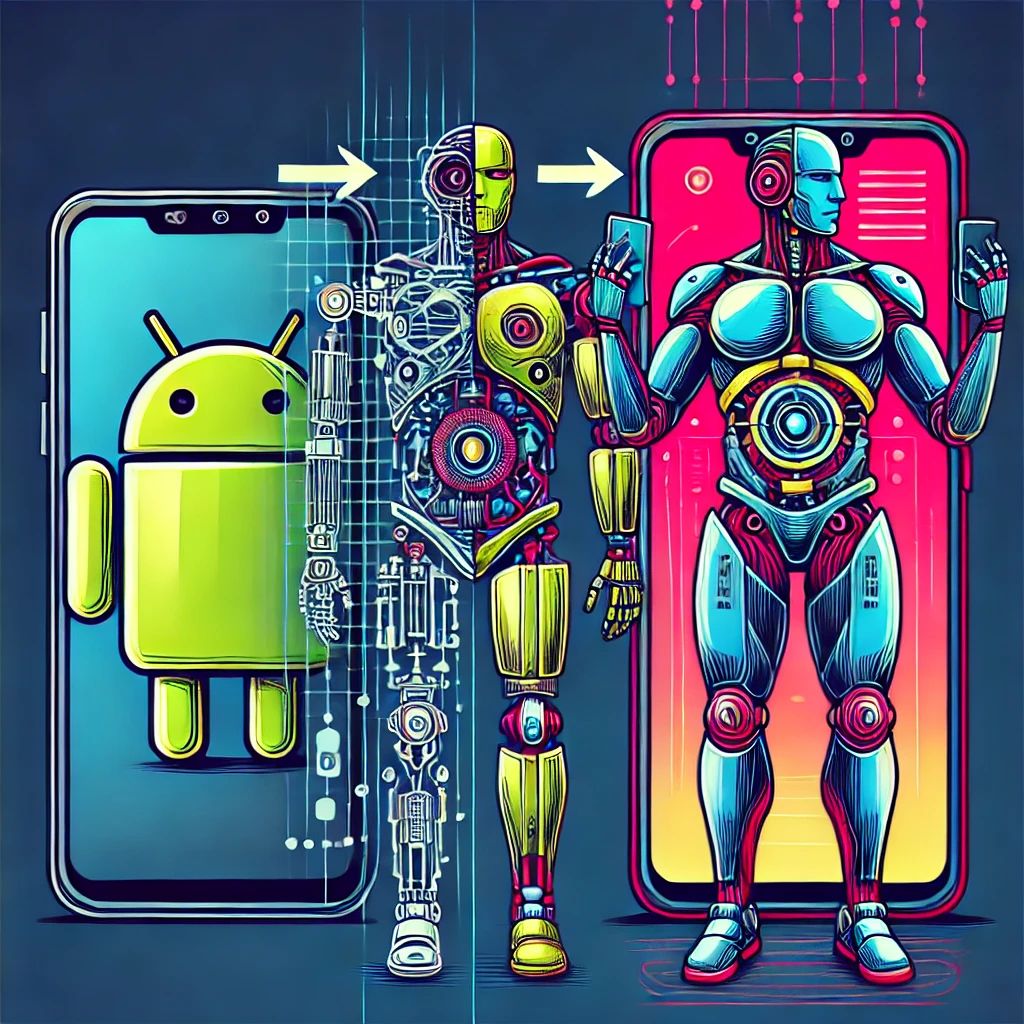
Index note GPT flow graph phone→robot
Mixed authorship: this post combines the author's own writing with text generated by an AI assistant (ChatGPT, Gemini, DeepSeek, Grok or Google AI), usually pasted in and labelled by the author.
Flow Graph: Teleconverting an Android Smartphone to an Actual Android
- Initial State: Smartphone
- Android smartphone with standard functionality (calling, apps, etc.)
- Hardware components: screen, CPU, battery, camera, sensors, etc.
- Stage 1: Activation of Teleconversion Protocol
- Initiate the teleconversion process via software command.
- System scans hardware for compatibility with teleconversion.
- Stage 2: Software Transformation
- AI Activation: Install advanced AI software for autonomous operation.
- Behavior Algorithms: Integrate machine learning algorithms for adaptive behavior.
- Human-Interaction Modules: Load software modules for verbal and non-verbal communication.
- Stage 3: Hardware Reconfiguration
- Expansion of Form Factor: Smartphone screen and body begin to morph into a larger structure.
- Material Shift: The smartphone’s casing transforms into a durable, flexible material suitable for an Android body.
- Component Redistribution: Internal components like CPU and sensors are redistributed to form the Android’s head, torso, and limbs.
- Screen to Face: The smartphone screen becomes the Android’s face.
- Sensors to Eyes/Ears: Camera and other sensors reposition as eyes and ears.
- Battery Integration: Power source is expanded to sustain the larger Android form.
- Stage 4: Final Assembly
- Limb Formation: Arms and legs are formed from the phone’s frame, with joints for mobility.
- Connectivity Enhancement: Integrate advanced communication capabilities for network connectivity and interaction with other devices/robots.
- Fine-tuning of Movement: Calibrate motors and actuators for smooth and human-like movement.
- Stage 5: Activation and Testing
- Self-Diagnostics: Android runs self-checks on hardware and software functionality.
- Movement Calibration: Test walking, gestures, and other physical actions.
- Communication Testing: Verify verbal communication abilities and response to human commands.
- Stage 6: Deployment
- Integration into Environment: Android is now ready for interaction with humans and other devices.
- Learning and Adaptation: Android begins learning from its environment to improve interaction and functionality over time.
- Final State: Fully Functional Android
- Android operates autonomously, interacts with humans, and integrates into the environment as a physical entity capable of performing complex tasks.
Above generated by chatgpt based on idea title.
Original: https://triton7777.wordpress.com/2024/08/17/android-to-android/