Triton 47 › XR & interfaces › The maker turn
Typing in the Air: A Futuristic Approach to Seamless AR Interaction
Index note finger IMUs + AR QWERTY; Rokid Air; Meta STAR
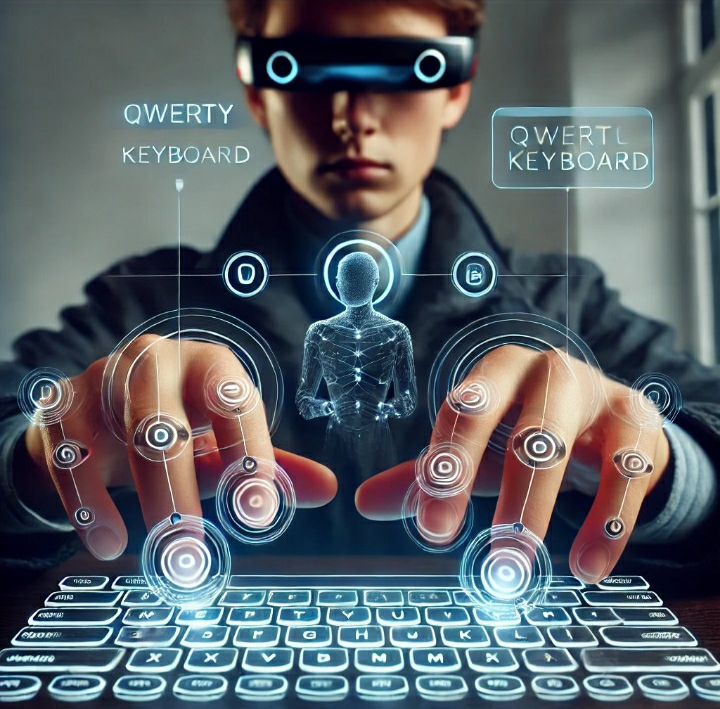
Imagine typing on a keyboard that isn’t physically there, yet every motion of your fingers in the air translates into text on a screen. This is the exciting vision of AI-driven mid-air typing, where smart motion sensors and augmented reality (AR) converge to change how we interact with computers. In this blog, we’ll explore how this concept works and its potential applications, using a system based on motion sensors attached to the hands, capable of interpreting every keystroke.
The Concept: From QWERTY to Air Typing
Our everyday typing relies on the well-known QWERTY layout. For each word we type, there is a specific sequence of finger movements that corresponds to the letters we want to input. Now, what if we could capture these movements in real time and have them translated into text without needing a physical keyboard?
This AI-powered system would use motion sensors attached to each finger, tracking their position and movement patterns. Just like when you press “A” with your pinky on a traditional keyboard, a motion sensor would record the specific motion in the air. The AI, trained to recognize this pattern, would map it to the letter “A” and send it to your screen, enabling you to type without ever touching a surface. With AR smart glasses, a floating virtual keyboard would appear, lighting up as your fingers hover over each virtual key.

The System: How It Works
- Motion Sensors: Small motion sensors attached to your fingers capture the movement of each digit. These sensors are equipped to detect acceleration, orientation, and exact motion paths, allowing the AI to decode the movements into individual keystrokes.
- AI Interpretation: AI models, trained to recognize typing patterns, analyze the sensor data in real-time, mapping hand movements to corresponding letters on a QWERTY layout. The system continuously refines its accuracy by learning each user’s unique typing habits, making the experience more intuitive with use.
- AR Interface: By wearing augmented reality glasses like Rokid Air or others, users can see a holographic QWERTY keyboard floating in front of them. As they type, the letters light up, offering a visual cue, and the typed text appears on a screen nearby or even directly in the AR interface itself.
- Seamless Typing Experience: This system would also utilize predictive text technologies, helping to compensate for any minor errors in finger positioning. As a result, users would be able to type quickly and efficiently, even without tactile feedback.
Applications of Air Typing in AR
- Augmented Workspaces: Professionals could use air typing in virtual work environments, where physical space is limited or when multitasking between different devices. Think of typing emails, coding, or drafting documents without needing to carry a laptop.
- Fitness and Rehabilitation: This system could help in rehabilitation scenarios, where individuals recovering from hand injuries could track their progress through detailed motion feedback while performing typing exercises in the air.
- Gaming and Immersive Experiences: In the gaming world, typing in the air could add an extra layer of immersion, allowing players to chat or interact with game elements without ever needing to look away from their environment.
The Future of Air Typing and AR
While this concept is still in development, early systems like Meta’s STAR, which integrates two-thumb typing on a virtual QWERTY interface, showcase how close we are to making air typing a reality. Research has shown that users can reach up to 22 words per minute with systems like STAR, which is promising as we move toward a more seamless and natural interaction with AR.
As AI continues to advance, we can expect improvements in speed, accuracy, and user adaptability. In the future, typing in the air may become the new norm, whether for professional work, gaming, or even daily tasks on wearable devices.
This innovative typing method has the potential to revolutionize how we interact with technology. With AI driving the interpretation of hand movements and AR providing an immersive interface, we’re just a few steps away from turning this futuristic idea into a practical reality.