Triton 47 › Journal › Products, permits, dimensions
Surrounding environment
Index note 3 images
I noticed something today and it reminded me of many memories. I noticed the same pattern, uh, subconsciously I had the information had the same pattern. I just didn’t notice it before. It’s that people wherever they go, they create, when they live in certain environment, they create the environment according to their own liking. And that environment is always the same to the person. I mean, a person managed to just make a newly rented home just like their old home, full of the same chaos, same kind of chaos. In and also the, even my mother, when we, when the family moved, the disorderly placement of things was the same kind. So, it’s, it’s not about the place, it’s about the person, how the person treats the surroundings, images surroundings, it’s the entire kind of, like a soul to it.
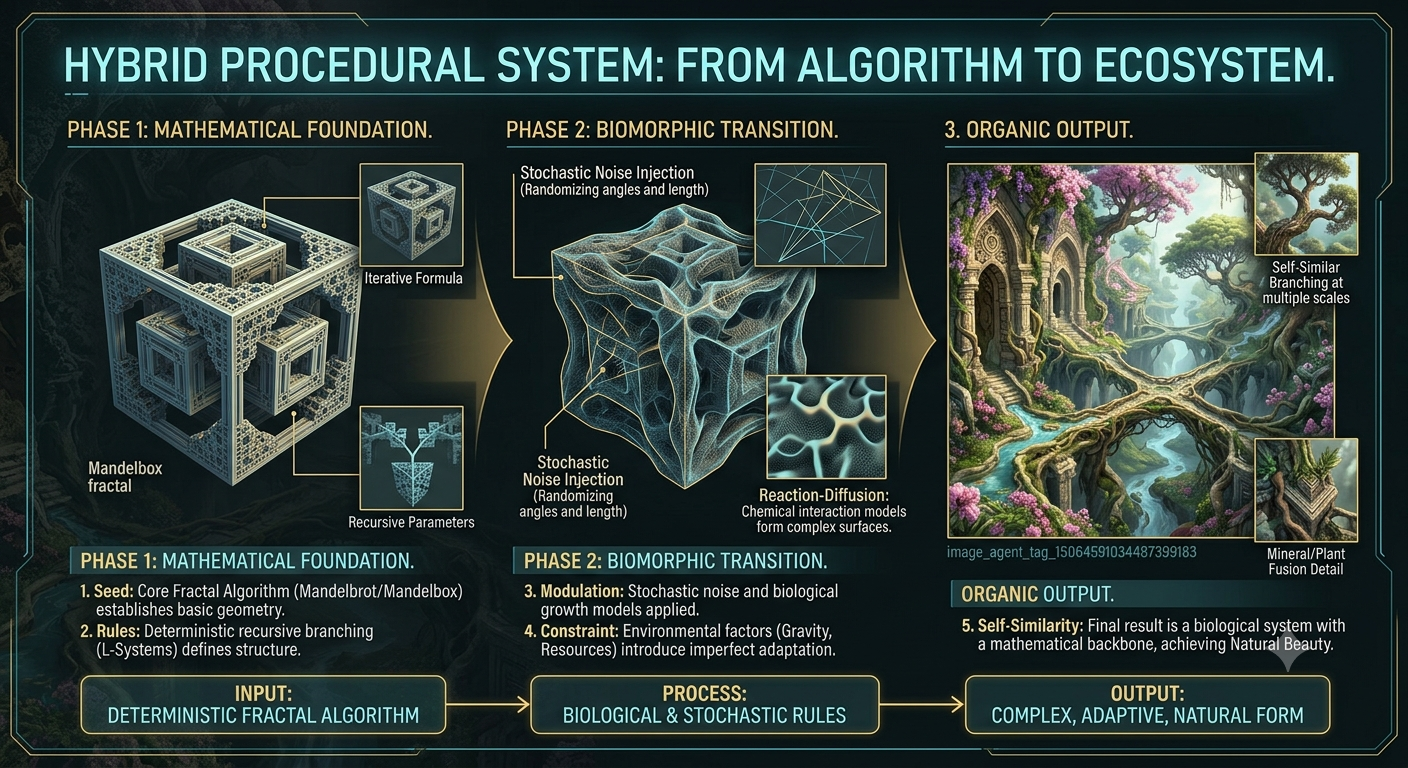
This transition from precise mathematical formulas to organic, natural structures reflects the concepts of biomorphic fractals and algorithmic botany.
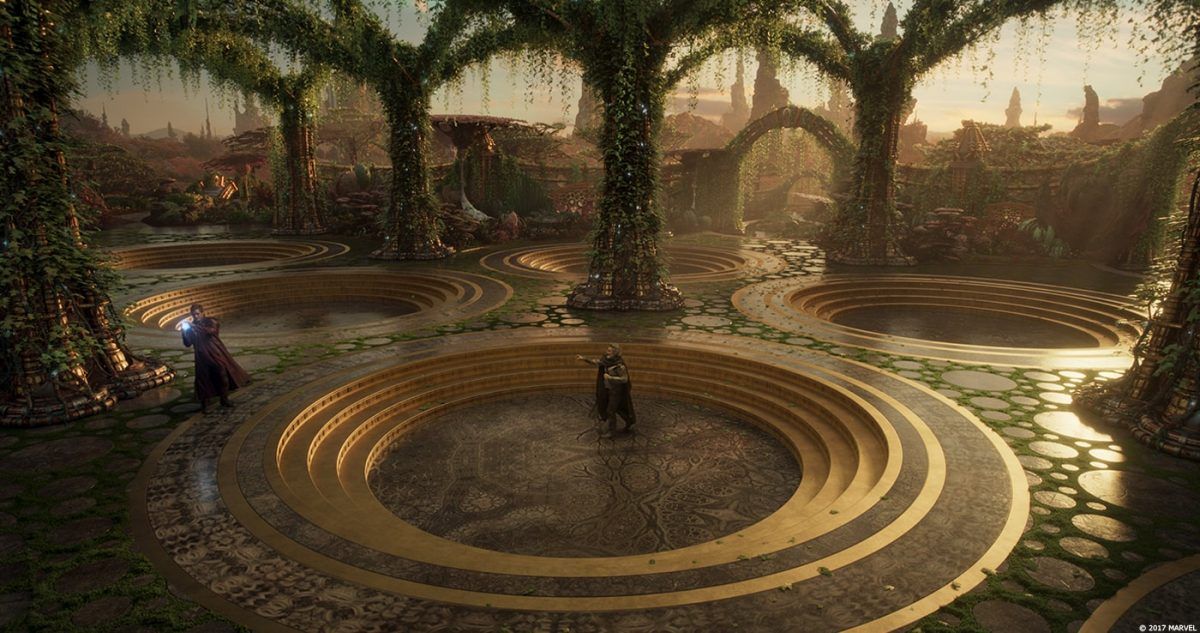
In Guardians of the Galaxy Vol. 2, Ego’s planet exhibits this explicit design framework. The visual effects team specifically used 3D Mandelbrot and Mandelbox formulas to generate the base architecture, layer by layer, before blending them with organic textures like vines, stone, and water.
The underlying mechanisms that govern this transition from formal mathematics to natural beauty include:
1. Lindenmayer Systems (L-Systems)
An L-System is a string-rewriting framework based on formal grammars, originally developed by biologist Aristid Lindenmayer to model the development of plant cells. It uses strict recursive rules to determine how lines branch. When ran for multiple iterations, these simple text rules generate highly complex, natural-looking structures like trees, ferns, and root systems.
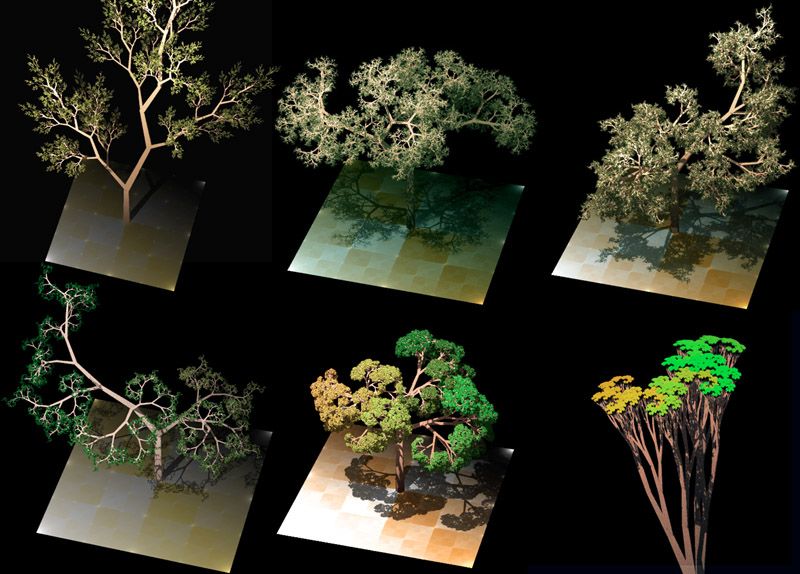
2. Stochastic Fractals (Adding Random Noise)
Pure mathematical fractals (like the Mandelbrot set) are perfectly deterministic and uniform. Nature, however, operates with constraints like wind, gravity, and resource limits.
- By introducing stochasticity (randomness) into the mathematical parameters—such as varying a branching angle by a few degrees or modifying length ratios dynamically—the rigid geometric pattern breaks down.
- The structure retains its self-similar mathematical backbone but adopts the imperfect, asymmetric look of real terrain, rivers, or trees.
3. Morphogenesis and Reaction-Diffusion
This is the biological process that causes an organism to develop its shape. Alan Turing’s Reaction-Diffusion model explains how complex natural patterns (like zebra stripes, coral structures, or cheetah spots) emerge from the chemical interaction of two simple substances dispersing through space. It begins as a uniform mathematical wave equation but resolves into organic, fluid boundaries.
The structure you are describing is a hybrid procedural system: it uses a rigid mathematical algorithm to lay the foundational topology and distribution, then applies environmental constraints and noise to simulate biological growth.
Original: https://triton7777.wordpress.com/2026/06/16/surrounding-environment/